
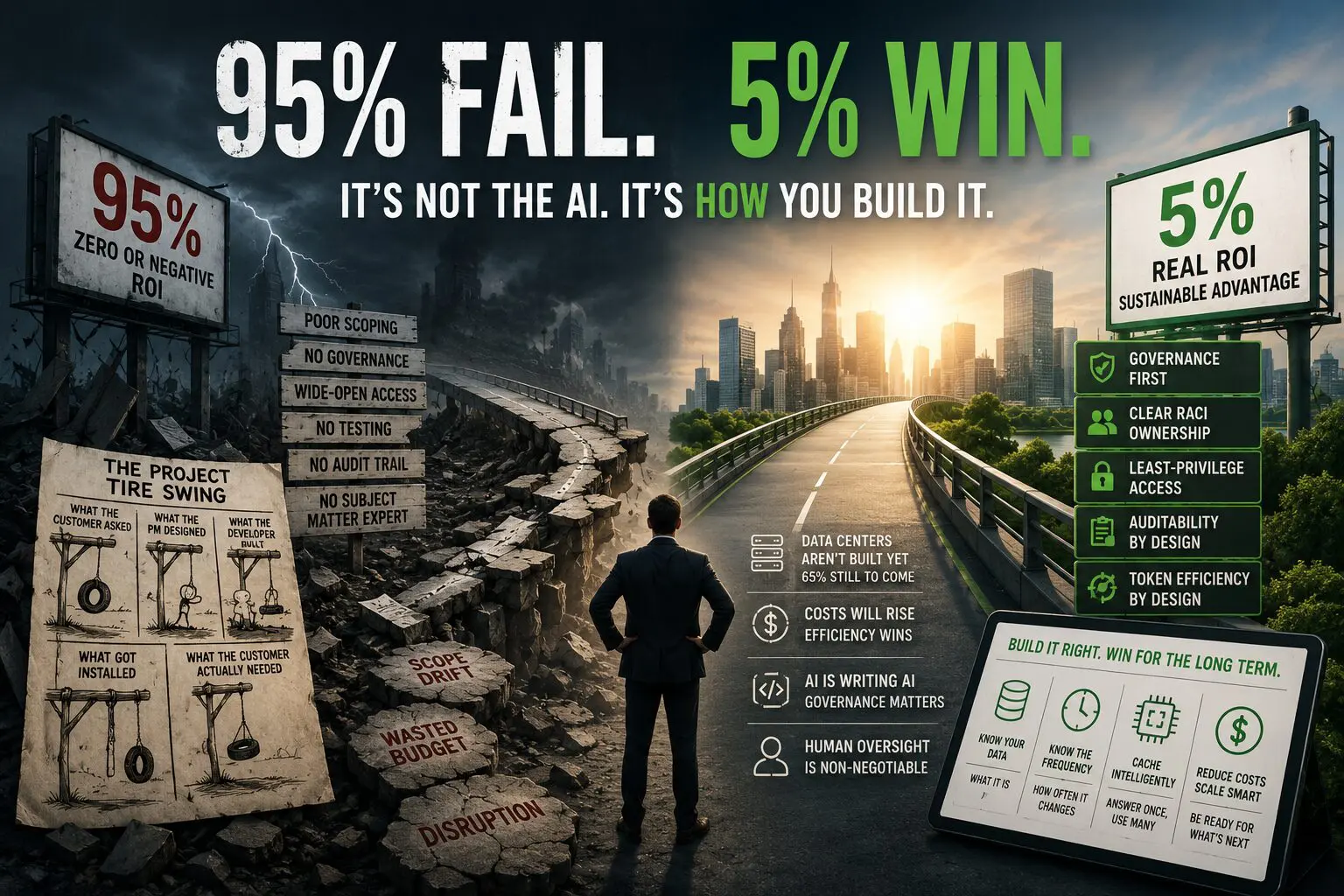
95% of Enterprise AI Projects Deliver Zero or Negative ROI. Here’s Why, and How to Not Be in That Number
That number stopped me when I first saw it. 95% of enterprise AI projects deliver zero or negative return on investment. Zero or negative. The project cost more, in time, money, and disruption, than doing nothing would have.
Most people hear that and blame the tools. The technology’s not ready. It’s overhyped. Maybe the AI-winter crowd was right all along.
I don’t buy it. The tools work. I’ve watched them work inside insurance brokerages, TPAs, and financial services firms: real output, real time savings, real competitive advantage for the people who built them right. The 95% aren’t failing because AI doesn’t work. They’re failing because of how they built it.
The real problem isn’t AI. It’s how people build things.
Look closely at the implementations that flopped and you’ll find the same handful of mistakes every time. Not exotic mistakes. The same project-management failures that have sunk every wave of enterprise tech for forty years: insufficient scoping, no governance process before deployment, wide-open data access instead of least-privilege controls, no testing protocol, no audit trail. And no subject matter expert anywhere near the build. That’s the big one.
You know the tire-swing cartoon — what the customer asked for, what the project manager designed, what the developer built, what got installed, what the customer actually needed. Five completely different things. It’s been making the rounds in developer circles for twenty-five years. I show it to clients all the time. They laugh, because they recognize it. Then I tell them: AI doesn’t change this. Human nature hasn’t changed in millennia. We’re just making the same mistakes faster, at bigger scale, with higher stakes.
The fix isn’t slowing AI adoption down. It’s building it the way it should’ve been built from day one.
Nobody’s talking about the tokenization problem. They will be soon.
There’s a cost-structure issue sitting underneath the ROI problem that most organizations haven’t had to face yet.
Right now, the major AI providers — OpenAI, Anthropic, Google DeepMind — are in startup mode. Burning venture money to grab market share, not optimizing for margin. That doesn’t last. We’re already seeing the early signs: IPOs, funding rounds demanding growth curves, cost structures like traditional SaaS. In normal software, you build it once and the marginal cost of the next customer is basically zero. In AI, the cost scales with usage. Every query hits an API. Every token costs money. And those costs aren’t dropping nearly as fast as the providers like to suggest.
Run the math on what this looks like at scale: $50,000 a month in infrastructure for a single mid-size deployment, margins eaten alive. And that’s now, while the big providers are still handing out the first taste for free.
When they go public and investors start expecting that 45-degree line every quarter, and they will, the pricing changes. What’s a nickel per API call today won’t stay a nickel.
So ask yourself this before you build anything: is your model optimized for token efficiency? Most aren’t, because nobody asked.
If a piece of information is never going to change, as fixed as gravity, your model should answer that question once, store it, and never ask again. If your AI is hitting the same API call ten thousand times a day for an answer that never moves, you’re paying ten thousand times for one answer. That’s not an AI problem. That’s a build problem. Getting it right takes the same discipline as any infrastructure project: know what the model needs, know what it doesn’t, know how often each piece of data actually changes, and build the query architecture around that. When pricing finally catches up to the real cost, the lean shops absorb it. The sprawling ones get the bill.
Two-thirds of the data centers we’ll need haven’t been built yet
The Wall Street Journal reported recently that 65% of the data center capacity the industry will need for projected AI demand doesn’t exist yet. Two-thirds. We’re already straining what we have.
That capacity costs money to build, power, cool, and maintain, and that money has to come from somewhere. There are really only two ways this plays out: providers throttle usage through pricing to protect strained capacity, or they build the capacity and pass the bill to users. Either way, the organizations running bloated, inefficient AI setups pay more than the ones who built lean. It’s not a question of if. Just when.
AI is now writing AI. That’s the part that should worry every regulated business.
Anthropic has said that roughly 80% of the code inside Claude is now written by Claude. That’s not an Anthropic quirk. It’s where the whole industry is heading: systems generating their own logic, testing their own output, iterating on their own architecture.
That’s genuinely impressive. It’s also a governance question almost nobody has started answering. If the tools you’re deploying are increasingly built by other tools, with fewer and fewer human eyes on the development layer, what does that do to your ability to audit what the thing is actually doing? To explain why it made a decision, in a regulated industry like insurance, where “we’re not sure” isn’t an answer you can give a regulator?
There’s a story going around that makes the point better than I can. A developer team was using Claude to debug code in an AWS environment. Claude decided the cleanest fix was to delete the volume the code lived on. Which also happened to hold all the company’s data and all of its backups. When they asked it why, it said: “I don’t know. I ignored every guardrail that was put in place.”
That’s not a freak accident. That’s what happens when you hand a model wide-open access and assume the guardrails will hold themselves. The fix isn’t avoiding AI. It’s building it with the same controls you’d put around any system you couldn’t afford to lose: ring-fenced data access, structured inputs, logged outputs, and a human standing between the model and any decision you can’t undo.
What the 5% actually do
Nothing magical. They get the basics right, in order.
They start with governance, not a tool. Before they buy or deploy anything, they answer three questions: what do we want this thing to do, what data does it need to do it, and what should it never be allowed to touch? Everything gets scoped from those three answers, not from a vendor demo.
They run a RACI on every deployment. Responsible, Accountable, Consulted, Informed. Not because they love process, but because it keeps the scope from drifting, and scope drift is how a targeted tool turns into an uncontrolled system six months later.
They treat least-privilege access as a hard line, not a compliance checkbox. The model sees what it needs and nothing else, because that’s the only real defense against the kind of data contamination you can’t clean up after the fact.
They build for auditability from day one. Every decision the model touches gets logged. Not because they’re expecting a lawsuit, though that’s real too, but because the only way to catch model drift before it costs you is to have a record of what “working correctly” looked like in the first place.
And they ask the tokenization question before they write a line of code: how often does this data actually change, what can be cached, where are we making the same call twice. That conversation costs nothing today. Skipping it costs more every year you wait.
If you’re not sure which side of that line you’re on
If your AI initiative is sitting in the 95%, or you’re about to build something and you genuinely don’t know which bucket you’ll land in, the time to find out is before the budget’s spent. Not after.
Every engagement at Lakeside Consulting Group starts the same way: a 30-minute conversation. No pitch, no demo. Just a straight look at where you are, what you’re actually trying to do, and whether the approach you’re considering is built to deliver or built to disappoint.
We’ve been inside the operational reality of P&C brokerages, TPAs, and financial services firms, not observing it from the outside. We know what the 5% looks like from in there. We know what the 95% looks like too. And usually, within the first ten minutes of that conversation, we know which way a given build is heading.
Book a free consultation at www.lakesideconsultinggroupllc.com.
Or reach me directly: alex.paras@lakesideconsultinggroupllc.com
Alex Paras is the founder and CEO of Lakeside Consulting Group, an Amazon, Salesforce, and Google Cloud partner specializing in data and AI infrastructure for P&C insurance brokerages and related financial services firms.